24 October 2007

Public Mutual join the China's "bubble party"

Finally, Public Mutual's "China Fund" was officially launched yesterday. Look at its advertisement: "Take advantage of China's growing economy" with new PB China Pacific Equity Fund.

Big China Fund

I don't know which unit trust company start this, recently we always heard about this kind of "Big China Fund" launching in our country. Maybe the funds performed very well due to the current China's maket condition, the unit trust companies manage to attract a huge number of customers/investors. If Public Mutual do nothing, it may loss its attractiveness to the customers, and may loss its market share to the competitive companies. So... though a huge bubble is forming in China's stock market... "under the pressure of public's demand", Public Mutual launched this China fund finally.

I have a friend who had recently become a Public Mutual's representative, he was trying his best to persuade his clients into buying this newly-launced fund. (does he get more commission from selling this fund than selling others? I don't know). If you ask his oppinion about the bubble forming in China's stock market, you'll probably hear this: "don't worry... the market is not likely to collapse before the Olympics". Maybe this is just a persuading tecnique taught by his manager/supervisor, but it seems that he himself believe in this, because he will tell you that he himself already invest in this fund too. And, you know, a lots of people believe in this phrase. (Please don't tell me the fund managers of Public Mutual also believe in this bull-shit thing.)

With its great brand-name and strong sales-agent network, I believe that the size of this PB China Equity Fund can easily grow to RM 1 Billion. The biggest unit trust company in our country now is grabbing millions of ringgit from the public, and send the moneys into the China's stock market. (According to the fund's rules, when the huge money reaches, the fund managers can't keep them as cash. They must invest a certain minimum portion of the money into China's stock market, no matter how bad is the outlook for the market.)

If we assume that the same things are happening in other countries, then there will be trillions of money keep flowing into the China's stock market.

This is what I imagine:
"demand from public"
V
unit trust companies lauch "China funds"
V
huge money reach fund-managers
V
they had to invest into China's market
V
China's market is boosted into record high
V
"China funds" shows great performance
V
more funds launched, more money had to be invested into China
V
China market go even higher
.
.
.
so, this can explain why the bubble of China's market can keep growing, and growing, and growing.... It's not impossible for the Shanghai's index to touch 10,000 point by next year. Under the aids of information technology in this globalisation era, one of the biggest bubble in the history is forming. It's already out of control.
(Believe it or not, no government can control the market, include the powerful communist government of China.)
Warren Buffett already sold most of his stake in PetroChina. I'll keep my self away from China's market. If anybody want to join this bublle party.... good luck, and take care.

23 October 2007

Rising latex price & the glove-manufacturers

In this post, we'll see how the rising latex price affect the profitability of the latex-glove companies. (Latex is the raw material for glove-manufacturing, accountable for about half of the operational costs)

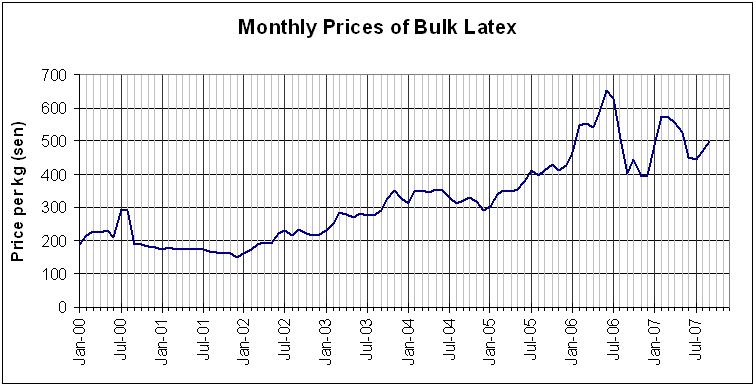
Here's the historical price movement of bulk latex:

Latex Price Jan-00 till Sep-07
source: Malaysian Rubber Board, http://www2.lgm.gov.my/Mre/YearlyAvg.aspx
[updated 30-10-2008: pls click here for the updated-verion of the chart.]

From the chart, we can see the recent price of latex is about 150% higher than that in 2001 & 2002. This definitely will rise the operational cost of latex-glove companies. But will it have a significant impact on their profitability?

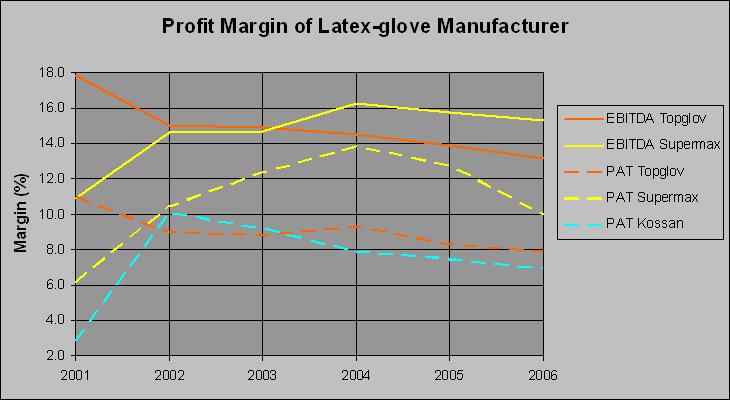
The following graph shows the EBITDA margins and PAT (profit after tax) margins for the three largest glove-companies in Malaysia:

Profit margin (graph)

While the latex price rise significantly from 2002 to 2006, the profit margin of these glove-manufacturers just show a small decline in the same period. This small decline in profit margins could be cause by other factors, e.g. rising financial cost for expansion of production lines.

So, I think we can say the rising price of latex has a minimal impact on the profitabilily of latex glove companies. They are always able to pass on the rising cost to their customers.

Again, I feel that Supermax is the best choice (for investment) among this 3 companies . From the charts, we can see that Supermax's EBITDA margin in 2006 is about 1% higher than that in 2002, while Topglove's EBITDA margin shows a decline of about 2%. This shows that Supermax's management is better in maintaining the company's profitability.

22 October 2007

On Time Performance of AirAsia & other airlines.

one reason I think AirAsia will continue to growth is its great on-time performance. An airlines that has a consistent punctuality will win the customers' respect and build up its name, thus gain a bigger market share in long run.

In this article, I just want to show: how good actually is the the on-time performance of AirAsia?

Here's the figures I get from AirAsia's website:
* a flight is considered on-time if it departs no later than 15 minutes from the schedule time.

AirAsia on-time performance 2007-09

From the chart, its two months (Aug & Sep) average performance is about 88%, Three months average (Jul~Sep) is about 85%.

We have to make a comparison to show how good is this figures. First, Lets compare the on-time performance of Jetstar Airways. (data from jetstar's website: http://www.jetstar.com/).

Jetstar on-time performance 2007-09

We can see that the on-time performance of AirAsia is as good as Jetstar's. And, Jetstar is the winner of the Best Low-cost Airlines (worldwide) in Skytrax's World Airline Awards 2007. I think this shows that AirAsia's performance is among the best in the world. (of cource, in this comparison, we assume that the figures announced on both airlines' website are true and reliable.)

Then, how about the comparisons with others airlines?

After some searching through the internets, I found that most Airlines do not publish their on-time performance on their web-site. However, we can get some statistics from http://www.flightstats.com/. Although the figures at this website only reflect the 20 most active routes for each airlines, it shouldn't be much different from the actual values.

Here's the figures I get from the website for some of the best airlines worldwide:
(statistic period: 15-Aug 2007 ~ 15-Oct 2007)

Low Cost Carriers:

Air Berlin

80%
easyJet80%
Jetblue Airways 76%
Jetstar Airways81%
Southwest Airlines83%
Tiger Airways 85%

Full Service Carriers:

Singapore Airlines

84%
Thai Airways79%
Cathay Pacific Airways 75%
Qatar Airways73%
Qantas Airways73%
Malaysia Airlines76%

(It is quite a strange phenomenon that the LCCs perform better than those full service carrier. I guess maybe it's easier to be on-time for short-range flights. )

Unfortunately, the statistics about AirAsia at http://www.flightstats.com/ is incomplete, because it contains only figures for routes to Macau (which is about 65% on-time). This figures of single destination may be very different from the overall performance of AirAsia. For other routes which they don't have any data, they just quote 0% on-time-performance and 100% flight-cancellation. This does not reflect the real situation.

So, we can't double check the reliability of the on-time performance figures announced at AirAsia's website. However, according to my own experience (I've flown with AirAsia twice in September, and each flight I took depart on-time) and some of my friends' recently, I personally believe that error on the announced figures should be within 5%. So, lets assume that the real figure is 5% lower than the officially announced, the two-month-average performance of AirAsia (Aug & Sep-2007) still stand above80% (88% - 5% = 83%).

Conclusion: AirAsia on-time performance ranks among the best worldwide. Its performance is much better than those full service carrier like MAS, giving it an opportunity to grab a bigger market share in the future. I belive LCC model will continue to shake the aviation industry, and AirAsia will continue to grow and become the leading LCC in the reagion.

21 September 2007

Supermax and other Latex Glove Companies.

the global demand on latex gloves has been growing exponentially in recent years. Since this growing trend of glove market is not likely to stop for the coming years (though it may slow down gradually) , the latex glove manufacturers will benefit a lots from it.

Malaysia's companies are the largest suppliers of latex gloves in the world. There are several latex glove companies listed on Bursa Malaysia. Here's a simple comparison based on their annual report FY2006:

Obviously, the three largest companies are:

  1. Topglove
  2. Kossan
  3. Supermax

The huge production capacity of these companies ensure that they can produce gloves with lower cost than their competitors. Hence they can maintain their profit margin while keep the selling price competitive. When I decided to buy a glove company, I only considered this three biggest companies. After doing some study, I've chosen to invest in Supermax.

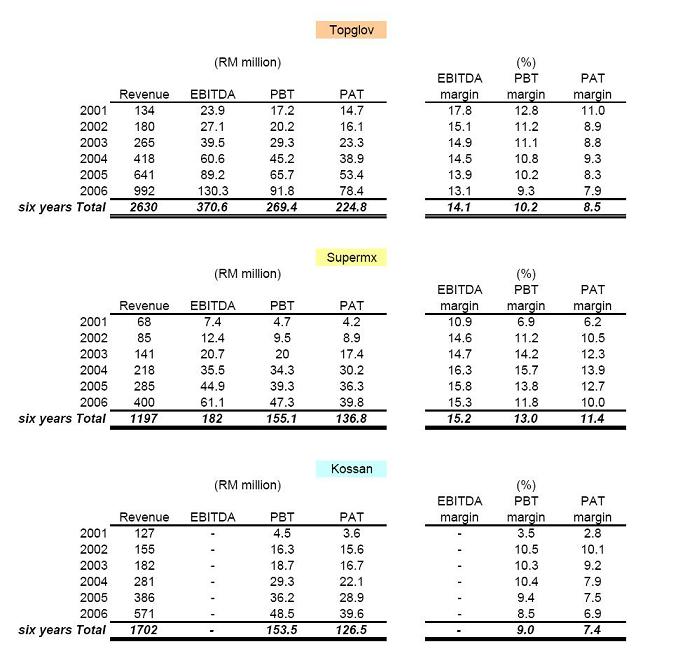
The first reason is Supermax has a better earning power. I've create a table to make a comparison between 3 companies:

(I don't have the EBITDA data of Kossan, but the comparisons of EBITDA should be similar to PBT and PAT)

Clearly, Supermax has a highest profit margin among them. This is a result from the continuous effort of its managment in controlling the cost. The 2% difference in profit margin can make a very big difference, especially when the market become gradually saturated and tough competitions occur. So, I think Supermax will become the last winner, though its growth rate in recent years is a little slower than Topglov and Kossan.
At the end of Sep-2007, when the privatisation of Seal Polymer is completed, Supermax is going to beat Kossan and become the 2nd largest glove company. If Supermax privatise APLI in the future, it will become almost same size as Topglove.
Another reason I choose Supermax, is because the price of Topglove and Kossan are already too high. Look at some figures relating the share prices of these companies:

Topglov

Supermax

Kossan

PAT '2006 (RM million)

78.4

39.7

39.5

No. of share (million)

300

227

160

Earning per share (sen)

26.2

17.5

24.7

Share price (RM)

6.2

2.4

4.5

Equity per share(RM)

2.0

1.2

1.3

Price/Earning ratio

24

14

18

Price/Equity ratio

3.1

2.0

3.4

* the no. of share & equity per share are based on the latest quarterly report.

Due to my investment prinples, I'll never buy a company that has a PE higher than 15, no matter how good is the company. So, I'll never consider to buy Topglove though it's the biggest latex glove company, unless its share price fall below RM4.50. Besides, Supermax's Price/Earning ratio and Price/Equity ratio is significantly lower than the other two, This make Supermax a better choice for a secure investment.

19 September 2007

Reasons of buying Supermax

Let's have a quick look on Supermax. With its current share price of about RM2.40,

  • the P.E. ratio based on the profit for FY-2006 is about 13.
  • the net asset per share is about RM1.20, about half of its share price.
  • the liability to equity ratio is about 1.0

As we can see, the figures are not very attractive. Its share price is not at a bargain level, nor is it very expensive. I may consider its current price is quite 'fair' due to its latest financial condition. I invested in Supermax not because of its cheap price. I invest in it because it is a continuous growing company with a bright future.

As Warren Buffette said, "it's much better to own a wonderful company with a fair price, than buying a fair company with wonderful price".

This is what i feel when I invested in companies like AirAsia and Supermax.

Supermax has some criteria that make it a wonderful company that worth to buy:

  1. Simple business model - manufacturing of rubber gloves
  2. Growing market for its products
  3. Good management
  4. Profitability - Consistent profit margin

Let's go through these one by one:

1. Simple Business Model Supermax has only one core business – Manufacturing and selling rubber gloves. It has a wide range of rubber gloves, made of natural latex or synthetic rubber. Its products are mainly for dental and medical use. Most of the products are exported, mainly to U.S. and Europe.

The merge between Supermax and Seal Polymer is going to be completed by the end of Sep-2007. Seal Polymer is involved in the similar business as Supermax. I like a company that grow while concentrate on its core business.

2. growing industry. The demand of rubber gloves has been growing in recent years, due to the growing health conscious and hygiene awareness, especially in the advanced countries like U.S. and Europe's. And the most important point is, the demand on medical gloves will only keep growing, independent of economical cycle. Hence, Supermax has a consistent growing market. From 2002 until now, Supermax’s revenue and profit had recorded an average growing rate of about 40% per year. I’m confident that its growth rate will be maintained above 20% per annum for few more years.

After merging with Seal Polymer, Supermax now has become one of the biggest manufacturers of rubber gloves in the world.

3. Management Team Tthe financial condition of Supermax is better than other glove companies in Malaysia, due to the continuing effort of its management, under the leadership of its CEO, Mr Thai Kim Sim.

Two years ago, Supermax had acquired shares of Seal Polymer and APLI, and became largest shareholder of these companies. Mr Thai had then become new CEO of these companies. At that time, APLI was suffering loss; and Mr Thai had turn APLI into profitable in early 2007. This is an evidence showing his ability of managing a company, especially in reducing operational cost.

about two months ago, most glove manufacturers in Malaysia faced an allegation by Tillotson Corporation (a U.S. company), of patent infringement of nitrile gloves. Supermax then announced that they will pay the loyalty fee to Tillotson Corporation, for all its nitrile gloves selling in U.S. This immediate response shows that Supermax's management is paying respect to intellectual property of other party.

4. Consistent Profitability About 50% of its cost is the raw material – latex. In recent years, the price of bulk latex rose from RM2 per kg (year 2002) to about RM5 per kg now. But the EBITDA margin of Supermax is maintain at about 15%. So I never worried about the rising price of latex, because Supermax is always able to pass the rising cost onto its customers.

Besides its consistency, Supermax's profit margin is also better than average value of other glove companies. So, it will always be profitable while selling its product with a competitive price.

.

.

[updated 10/10/2008]: I sold Supermx at the end of September-2008. Please read this post for the reason.

.

Related Posts Plugin for WordPress, Blogger...


SPONSORS: