10 October 2008

My portfolio at 30-9-2008

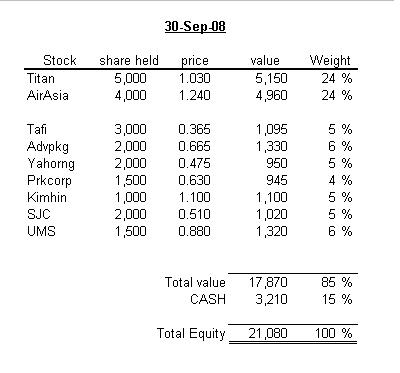
The composition of my portfolio at the end of September is as follow:
portfolio_2008-09-30

I didn't add any money into my account during this quarter. At the end of September, I sold all my holding on Supermx.

I need cash to build my “value-stock portfolio”. Since I don't have extra savings during these months, I'd decided to sell one of my holdings. Compared to the other two companies that I invested (Titan and AirAsia), the management of Supermx is the one that I have least confidence in it. So, it become the first company I decided to sell when I need cash.

Rubber-glove manufacturers are still one of my favorite companies to invest. I’ll come back to them when I have extra cash savings. However, the next time, I think I may be more interested in Kossan instead of Supermx.

My evaluations on the glove manufacturers had changed during this year, mainly influenced by Fisher's writing Common Stock and Uncommon Profit. I had just done my reading on the book few months ago.

.

06 September 2008

Seni Jaya Corporation Bhd

This is another company that I bought into my value-stocks portfolio yesterday. My buy price is 53 sen per share, which is about 75% of its net working capital.

Other good criteria in this company are:

  • zero debt.
  • stable revenue and profit since year 2001.
  • Good dividend. Its latest dividend payment is 5.0 sen (less 26% tax) per share, which had been paid out few weeks ago. Compare to my buy price, this figure give a net DY of about 7%. (Dividend in previous years are less, but quite stable).
  • Plenty of Cash (about 60 sen per share).

Similar to other companies in my value-stock-portfolio, SJC has a very low trading volume. I've been watching and quoting for it since few months ago, but only managed to get a match on yesterday.

UMS Holdings Berhad

Few months ago when I discovered this stock, it is reported that there's a fire incident occured at the company's store in February 2008. I decided not to buy it because the impact from the fire incident was unknown.

Last week, its lasted quarterly report (Jun-2008) said that the extent of damage to date was approximate RM389,000 only, which is, in my opinion, not quite significant to the company's operation. So, I decided to select it into my value-stocks portfolio.

I managed to buy UMS at 70 sen per share yesterday. According to its latest quarter-report, this price is only equal to 60% of its net working capital per share. Other factors are:

  • very low debt. (borrowing/equity less than 10%)
  • stable profit in the past seven years.
  • net DY more than 5% in the past four years.
  • low PE ratio. (about 5, based on three years average EPS)

.

Caution about this company:

  1. It has high amount of receivables and inventories, compared to its yearly earnings. Both figures are about 4 times of its PAT. However, when compared to its revenue, these figures are still acceptable. The inventories and receivables are maintained around 40% and 30% of its revenue respectively.
  2. There may be some consequential loss (due to the fire incident described above) that yet to be finalized. In my opinion, it shouldn't have any significant impact on the company. However, I may be wrong.

.

28 August 2008

Kim Hin Industry Bhd

Two days ago, another company is selected into my "value stock portfolio".

Kim Hin is a company located at East Malaysia, mainly involve in manufacturing and sale of ceramic tiles. I bought it at the price of RM1.15 per share, which equals 88% of its net working capital.

other supporting reasons:

  • zero debt.
  • continuous profit for many years (one exception occur at 1998).
  • uninterrupted dividend payment for more than 10 years.
  • cash per share of about 53 sen. (base on its Mar-2008 quarterly report).

.

Special Item:

Under the list of its non-current assets, there is an "other investment" item worth about RM 67 million. (base on Kimhin's Mar-2008 quarterly-report)

According to the footnotes in the report, this "other investment" item is mainly made up of bonds, fixed income funds, structured products, etc. All of them are very low risk investment. And in my opinion, they can easily be converted into cash!

If we treat them as cash, then the total cash in Kimhin will become RM 1.0 per share. And if we include the value of these investment into its current asset, then the net working capital of Kimhin will be more than RM1.70 per share. That means my buy price of RM1.15 would be just about two third (67%) of its net working capital, (exactly the Graham's ratio).

.

07 August 2008

Perak Corporation Bhd

PRKCORP, a new company that I've just added into my "value-stock" portfolio this week.

I bought it at the price of RM0.75 per share. According to its Mar-2008 quarterly report, its net working capital per share is about RM2.25, which means that my buy price is only about 35% of its net working capital, thus provide a good margin of safety.

Other supporting reasons:

  • Cash per share about 80 sen. (as Mar-2008)
  • Price-earning ratio is only about 6, calculated from latest 3 years' average EPS.
  • Continuous profitable since 1995, including years after the 1997 economic-crisis.
  • consistence dividend payment since 2000. (though the dividend yield is quite low).
  • It main profit come from the business in Lumut Port, which I think is a locally monopoly business.

.

However, there is one thing in PRKCORP that is quite different from my other "value stocks" -- It is not a debt-free (or very low debt) company. In other words, it doesn't meet all the requirement that I have listed out for this portfolio.

Though I think that the very low price/net working capital ratio has given me a good margin of safety, there are few more things that have to be take note:

  1. the figures for net working capital and cash per share stated above, they are just the group consolidated figure. I didn't take into account the minority interest.
  2. The huge cash that PRKCORP held is actually still less than its total borrowings, which means it's not in a net cash position. So, I see the Cash as an indicator of financial health (i.e. its profit is generating net cash inflow), rather than a strong safety factor.
  3. The very big portion of PRKCORP's current asset is actually receivables and property development cost. The amount from each of them is higher than the revenue of the company (or, in other words, a few multiples of the company's annual profit).

.

Related Posts Plugin for WordPress, Blogger...


SPONSORS: