01 March 2010

IQ Group Holdings Bhd

This is the new company being bought into my value-stock portfolio today.

I bought it at 50sen, which is a discount of more than 40% from its net-working-capital per share (based on its Dec-2009 report).

Other good criteria of this company:

  • Plenty of cash (about 35 sen per share).
  • zero borrowings.
The stock is currently trading near its historical low price. The PE ratio is around 10, based on its three years average earning of FY2007~2009.

The company was listed on Bursa since 2005. Its profitability had been falling through these years, and suffered a small amount of lost in FY2009. It stopped paying dividend since 2008.

For the FY2010, a profit of 2.5 sen per share was recorded for the 9-month period ending Dec-2009. No dividend had been declared yet.

The investment decision today is kind of Walter Schloss' style. Walter likes to purchase companies when they were facing problem, i.e. when their profit and dividend fell, provided that the company had no debt. And he likes to bought companies at prices near their historical low.

.

28 February 2010

Great Investor -- Walter Schloss.

One of the greatest successor of Graham's value-investment philosophy.

It's because of him, that I had decided to start an experimental portfolio applying Graham's net-working-capital strategy. During his investment lifetime of nearly 50 years, Walter had achieved an incredible return rate of about 20% p.a..

Yet, a lots of people never heard about him.

So, this is a short introduction about Walter Schloss (more precisely, a short summary of what I've read about him on the internet).

.

Walter never went to college. He was employed and worked in Graham's firm for nearly ten years. When Graham decided to retire and winding up his firm on 1955, he introduced Walter to some of his clients. And that's how Walter started his own career, with a "net-working-capital" fund.

Walter's investment style is very different from Warren Buffett's. While picking stocks, Walter focus only on tangible asset. He always had a well diversified portfolio, holding more than 100 stocks most of the time.

Walter describe himself as:

  • doesn't like to lose money.
  • doesn't understand business.
  • not good in judging people.
  • didn't visit the companies that he invest, or talk to the management.
  • never predict the market, never bothered about economics.
  • likes to invest in company that has very little or no debt.
  • likes to see that a big portion of a company's stock owned by the management.
  • likes to buy companies that are facing problem. (when their earnings and dividends drop)

.

Anybody who likes to understand more about Walter, here's some good links:

.

19 February 2010

A new framework for my Value-stock-Portfolio.

[阅读中文版本]

I started this experimental portfolio since 2008 (see here). After two years of practicing, I had done some review and had decided to make some modification on the strategy framework.

.

Entry strategy:

  • buy at price lower than 70% of net-working-capital.

a single criterion for stock selection.

This is to make my strategy as simple as possible. In the past two years, I found that it's not hard to find a number of stocks that fulfill this criterion. However, those companies that are suffering lost, or having problem of management's integrity, are definitely out of the list.

Other figures e.g. PE, DY, cash per share, etc. will only be used as supplementary guidelines.

.

Exit strategy:

  • sell at price between 80% to 120% of net working capital.
  • maximum holding period for each stock is 4 years.

Of course, the ideal exit-price should be above NWC, but I have less confident that every stock in the portfolio will rise above this level. Thus, I need some flexibility.

To determine the suitable selling price (within the 80~120% range), other factors are used as reference, e.g.:

  • PE、DY、quality of assets, etc.
  • target return rate.

I hope that this strategy can be made more simple in the future.

.

Target return rate

  • for entire portfolio: 25% p.a.
  • for each stock in the portfolio: at least 30% p.a.。

Two years ago, I set a 20% p.a. target for the portfolio. That was actually the results achieved by Walter Schloss (who keep practicing net-working-capital strategy) in his 50-year investment lifetime. But recently only I realized that the potential return for this strategy should be higher here, because we have no capital-gain-tax in Malaysia.

Since the portfolio is not always in 100% equity position, and some stock may fail to achieve the target, it's reasonable to have higher target on each single stock than the target of entire portfolio. For those stocks that have good quality, like high DY, low PE, healthy balance sheet, etc., I would aim for a higher target e.g. 60% p.a.

.

Risk Management:

  • Weight on each stock shall not exceed 15% of the portfolio value (at the time of purchase).
  • Avoid investing in companies of same industry. If there's really a good opportunity, the weight on each industry should not exceed 20% of portfolio.
.

x x x

From now on, all investment decision in my value-stock-portfolio will be made based on this new framework.

.
11 February 2010

Rex Industry Berhad

[阅读中文版本]

The new member of my value-stocks-portfolio.

I bought it at 65 sen per share, a 47% discount from its net-working-capital (according to its Sep-2009 report).

However, judging from any other view, Rex doesn't sound like a good investment choice:

  • its PE ratio is high.
  • bad dividend record (didn't pay dividend from year 2002 ~ 2006). DY of 2007 and 08 is quite low too.
  • its profit margin showed a trend of descending during the past ten years. Though its revenue boosted up in recent years, PAT continued falling.
  • high investories & receivable.
  • trading volume of shares is very low.

In other words, the decision to invest in Rex is purely Graham's net-working-capital approach, without any other supporting point (e.g. low PE, high DY, high cash, low debt...).

Hence, this transaction is a meaningful case-study to test my net-working-capital strategy. If the return from this investment turns out to be good ( > 20% p.a.), it would be a strong support for me to continue practicing this strategy.

.

02 January 2010

My Portfolio at the end of 2009.

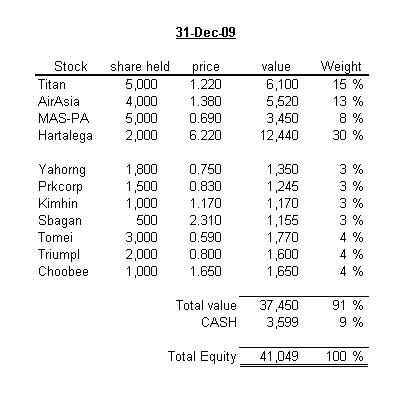
Here's the composition of my portfolio at 31-Dec-2009.

portfolio_2009-12-31

Activities during this year:

  • Stocks sold: Advpkg, Lysaght, SJC, UMS, Tafi.
  • Stocks bought: Hartalega, Tomei, Triumpl, Choobee.
  • Money added: RM 9,100 in the middle of the year.

If being asked what I'd feel regret about my investment during this year, it would be my slow reaction in buying Hartalega. Its price was below RM3.50 when it first came into my sight, but I only took action when its price went above RM4.50 -- Lesson learned: take action immediately when you found a good company trading at an attactive price. This event also strengthened my believe in long-term buy-and-hold strategy.

For the year 2009, my portfolio's average return rate is about 41% p.a., a bit lower than KLCI's performance.

.

Related Posts Plugin for WordPress, Blogger...


SPONSORS: