11 July 2008

Ya Horng Electronic (M) Bhd.

This is the new stock that I’ve added into my “value-stock portfolio”.

I bought it at a price of RM 0.550 two days ago. According to its latest quarterly report (April-2008), its net working capital per share is about RM 1.32, which is more than double of my buying price!

Other criteria found in this stock are:

  • Zero debt. (no borrowings)
  • Cash per share of about RM 0.65. (at Apr-2008)
  • Low PE ratio (about 6, three year average)
  • Consistent, uninterupted dividend payment for many years, and net DY > 5% in each of the past ten years (according to my buy price of 55 sen).

I bought the stock just few days after the execution date of its latest dividend (5 sen less 25% tax). So, I didn’t enjoy the latest dividend, and its cash per share should be around 61 sen now. However, my buy-price is still about 10% lower than its cash value.

There are also some negative sides of this stock:

  • Its inventories and receivables is very high compare to its PAT. But they are still acceptable if compare to its revenue.
  • Its profit margin is very low (about 2% in the past two years), and the margin show a decreasing trend in the past ten years. Some may say that it's in a "sun-set industry".
  • The liquidity of its stock (trading volume) is very, very, very low.

The last point is the main reason why I didn’t buy it earlier though I’ve discovered it few months ago -- my quotation just couldn’t be matched.

.

10 July 2008

Selling Stock

This is the first time I've decided to sell my holdings since I started this blog.

In the beginning of July, two stocks in my portfolio had been sold.

.

RUBHD

Sell at RM3.48.

Though I think that it should worth more, I don't think that the price of the take-over offer by Ranhill will be revised to a higher price. So, to save my time and utilise the money for other investment opportunity, I have decided to sell it.

.

AKN

Sell at the price of RM 0.385.

A friend had decided to buy AKN after reading my blog. Then we started some discussion in a forum. During the discussion, some other friends give us warning signals about the integrity of its management. Though I can't be sured that they are right, I think that selling off AKN is the best way to protect my self.

However, I’ll keep observing the future development of AKN.

.

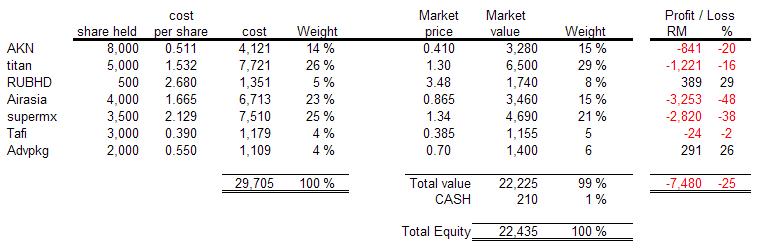
My portfolio at 30-6-2008

Here's my portfolio at the end of June this year:

portfolio_2008-06-30

Note:

I've added RM 1050 into my portfolio in this quarter. The money was used to buy another 1000 shares of AirAsia. Other composition of my portfolio remain unchanged.

.

15 June 2008

Why I'd never worried about AirAsia's debt.

One of the reasons that investors don't like AirAsia is the huge amount of CAPEX and borrowings.

In this article, I'll discuss how good is AirAsia in managing its debts.

1. Interest rate hedge

Interest rate hike is a essential risk for highly debted company. AirAsia hedges against the risk by entering into interest rate swap contract that will convert almost all of its debt into fixed rate debt.

According to its Dec-2007 report, AirAsia’s swap contract obliges it to pay fixed interest rate of between 4.78% and 4.90% instead of being subjected to the floating US-LIBOR for the entire loan amount over the entire tenor.

The hedging of interest rate will stabilize AirAsia' future cash flow, and help it to maintain the current low interest rate throughout the whole repayment period.

2. Forward foreign exchange hedge

As the borrowings of AirAsia are all in USD, it will benefit from the depreciation of USD. Moreover, Airasia had entered into forward exchange contracts for settlement at fixed Ringgit rates when the USD had depreciated.

For example, as disclosed in Dec-2007 report, AirAsia had swap its RM3.3 billion equivalent debt into ringgit at exchange rates between RM 3.000 ~ RM 3.369. Because the exchange rate of USD to Ringgit is much higher when it borrowed the money, AirAsia is actually making a profit from the repayments of principal loan amount.

These profits from foreign exchange had been recorded in AirAsia’s income statement. In the latest quarterly reports, we can see that the financial cost of AirAsia is a positive value (which means it’s an income, not expenses). This is because the foreign exchange gain from the repayment of debt is higher than the interest expenses.

The following table shows AirAsia’s interest expenses & foreign exchange gain during pass two years.

foreign exchange gain

And the most important part is, these exchange profit are recurring! (because AirAsia had swapped its debt into ringgit at a favorable rate.) With this recurring income, I never doubt the ability of AirAsia to pay the interest of its loan.

3. Tax Incentive

AirAsia has been granted a great amount of tax incentive from our government, for its CAPEX in purchasing aircrafts.

How much is the tax incentive? Let’s look at the recent figures.

Tax incentive

From my own estimation, for every dollar AirAsia spent in purchasing aircrafts, the tax incentive incurred is enough for it to pay the loan interest for at least 3 years! As the repayment period of AirAsia’s loans are only 12 years, the tax-incentives had actually helped to cover a substantial part of its financial cost.

So, why not borrowing?

Let’s look at this tax incentive from another angle of view. The following table shows the PBT of AirAsia and the tax it should have paid if there’s no incentive:

Tax

And the actual taxes paid by AirAsia during this period are:

  • FY2006:RM 2.2 million.
  • FY2007:RM 5.1 million
  • July-Dec 2007:RM 1.5 million

Can you see how much tax savings had AirAsia been enjoying? This a main reason why I've never worried about the high CAPEX of AirAsia.

In fact, the fast expansion of AirAsia, leveraging on financing facilities, is one of the factors that enable AirAsia to maintain its profitability. Because in the highly competitive LCC industry, only the lowest cost player (through effective cost reduction, economic scale, and fast penetration into the market) will survive and prosper.

Since it's able to manage its debts so well, I think AirAsia's way of expansion (through borrowings instead of issuing new shares) is the best way to benefit the shareholders without diluting our interest in the company.

.

[updated 29-10-2008]: There's a serious mistake in this article -- the foreign exchange gain reported in AirAsia's income statement is not a real gain. Though I don't know the exact figure, I'm quite confident that AirAsia's actual (recurring) exchange gain/losses should be much smaller than the figures stated in this article. For more detail, pls read my post: Profit of AirAsia (part 1).

.
10 June 2008

Comment about Mar-2008 quarterly reports

AIRASIA

The result is better than I expected. Its operation in Indonesia and Thailand is improving despite the escalating oil prices. The environment for airline industry has become more and more challenging in this year. The record-high oil price and tough competitions in the industry will kick out some of the players, and those who survive——and I think AirAsia is surely one of the them——will benefit from it.

As I said, I will gradually increase my investment in AirAsia (up to the limit of 25% of my portfolio’s value). Currently, the only thing that worried me is the continuous drop of AirAsia’s load factor, which is about 68% in this quarter. However, I’m in confidence that it would be improved in next year, as a result from the ASEAN's sky liberation.


AKN

It surprised me with a proposal to sell off the businesses in Paramount Discovery. Its acquisition of Paramount Discovery about two years ago is one of the main reasons I invested in AKN. However, the proposed selling price of RM126.9 million is about four times higher than the acquisition price about two years ago. This means AKN will have a gain of about RM100 million in this transaction, which is equal to earning per share of about 80 sen.

This will help AKN to reduce its debts, cut the financial cost (hence improve its profitability), and achieve a healthier balance sheet. I hope these will boost AKN share price to a high level after the transaction is done, because I’m considering to withdraw my investment from AKN then.


RUBHD

The revenue and profit remain stable, as expected. Its reaction to WSIA remains uncertain. The scheduled tariff hike in Jan-2009——which is expected to boost its profit next year by at least 30%——remains the key reason for me to hold RUBHD.

But then a shockin news was announced last week, that Ranhill Berhad made a take-over offer on RUBHD. The offer price is only RM3.50 per share, which is 20% below its NTA. I really hope that this privatisation will fail, because RUBHD definitely worth much more than RM3.50!


SUPERMX

Revenue and profit is growing as expected. But the profit margin is decreasing, which is a warning signal to me. Although I feel that its current share price is very cheap as compared to its value, I'll rather stop accumulating Supermx. This is simply because the value of Supermx already made up a high percentage in my portfolio (about 25%). Currently, I need some diversification in order to reduce the risk of making mistake.


TITAN

As expected, Titan remain profitability despite the high oil price, and the polymer-naphtha spread is quite stable. I’m very happy to see the start-up of the butadiene plant and propylene plant has been carried out smoothly. Also encouraging is the increasing output from the Indonesia’s plant. The next step of Titan is the debottlenecking process of its polypropylene plant, which is expected to boost its Polypropylene capacity for another 100 KTA, by the end of this year.


"Value-Stocks" Portfolio - TAFI & ADVPKG

Advpkg had declared a tax-exempt dividend of 4.5 sen per share. This means I’m enjoying a net dividend yield of about 8% this year, which is higher than I expected. Maybe due to this higher dividend, its share price has been advance for more than 20% from my buy-price. However, I’m in the opinion that its current share price of about 70 sen is still under-valued.

Despite the declining revenue and profit,TAFI's share price remain quite stable.


Related Posts Plugin for WordPress, Blogger...


SPONSORS: