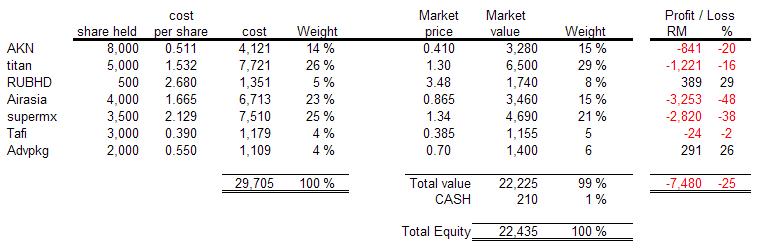
Here's my portfolio at the end of June this year:
Note:
I've added RM 1050 into my portfolio in this quarter. The money was used to buy another 1000 shares of AirAsia. Other composition of my portfolio remain unchanged.
.
Here's my portfolio at the end of June this year:
Note:
I've added RM 1050 into my portfolio in this quarter. The money was used to buy another 1000 shares of AirAsia. Other composition of my portfolio remain unchanged.
.
One of the reasons that investors don't like AirAsia is the huge amount of CAPEX and borrowings.
In this article, I'll discuss how good is AirAsia in managing its debts.
1. Interest rate hedge
Interest rate hike is a essential risk for highly debted company. AirAsia hedges against the risk by entering into interest rate swap contract that will convert almost all of its debt into fixed rate debt.
According to its Dec-2007 report, AirAsia’s swap contract obliges it to pay fixed interest rate of between 4.78% and 4.90% instead of being subjected to the floating US-LIBOR for the entire loan amount over the entire tenor.
The hedging of interest rate will stabilize AirAsia' future cash flow, and help it to maintain the current low interest rate throughout the whole repayment period.
2. Forward foreign exchange hedge
As the borrowings of AirAsia are all in USD, it will benefit from the depreciation of USD. Moreover, Airasia had entered into forward exchange contracts for settlement at fixed Ringgit rates when the USD had depreciated.
For example, as disclosed in Dec-2007 report, AirAsia had swap its RM3.3 billion equivalent debt into ringgit at exchange rates between RM 3.000 ~ RM 3.369. Because the exchange rate of USD to Ringgit is much higher when it borrowed the money, AirAsia is actually making a profit from the repayments of principal loan amount.
These profits from foreign exchange had been recorded in AirAsia’s income statement. In the latest quarterly reports, we can see that the financial cost of AirAsia is a positive value (which means it’s an income, not expenses). This is because the foreign exchange gain from the repayment of debt is higher than the interest expenses.
The following table shows AirAsia’s interest expenses & foreign exchange gain during pass two years.

And the most important part is, these exchange profit are recurring! (because AirAsia had swapped its debt into ringgit at a favorable rate.) With this recurring income, I never doubt the ability of AirAsia to pay the interest of its loan.
3. Tax Incentive
AirAsia has been granted a great amount of tax incentive from our government, for its CAPEX in purchasing aircrafts.
How much is the tax incentive? Let’s look at the recent figures.

From my own estimation, for every dollar AirAsia spent in purchasing aircrafts, the tax incentive incurred is enough for it to pay the loan interest for at least 3 years! As the repayment period of AirAsia’s loans are only 12 years, the tax-incentives had actually helped to cover a substantial part of its financial cost.
So, why not borrowing?
Let’s look at this tax incentive from another angle of view. The following table shows the PBT of AirAsia and the tax it should have paid if there’s no incentive:

And the actual taxes paid by AirAsia during this period are:
Can you see how much tax savings had AirAsia been enjoying? This a main reason why I've never worried about the high CAPEX of AirAsia.
In fact, the fast expansion of AirAsia, leveraging on financing facilities, is one of the factors that enable AirAsia to maintain its profitability. Because in the highly competitive LCC industry, only the lowest cost player (through effective cost reduction, economic scale, and fast penetration into the market) will survive and prosper.
Since it's able to manage its debts so well, I think AirAsia's way of expansion (through borrowings instead of issuing new shares) is the best way to benefit the shareholders without diluting our interest in the company.
.
[updated 29-10-2008]: There's a serious mistake in this article -- the foreign exchange gain reported in AirAsia's income statement is not a real gain. Though I don't know the exact figure, I'm quite confident that AirAsia's actual (recurring) exchange gain/losses should be much smaller than the figures stated in this article. For more detail, pls read my post: Profit of AirAsia (part 1).
.
AIRASIA
The result is better than I expected. Its operation in Indonesia and Thailand is improving despite the escalating oil prices. The environment for airline industry has become more and more challenging in this year. The record-high oil price and tough competitions in the industry will kick out some of the players, and those who survive——and I think AirAsia is surely one of the them——will benefit from it.
As I said, I will gradually increase my investment in AirAsia (up to the limit of 25% of my portfolio’s value). Currently, the only thing that worried me is the continuous drop of AirAsia’s load factor, which is about 68% in this quarter. However, I’m in confidence that it would be improved in next year, as a result from the ASEAN's sky liberation.
AKN
It surprised me with a proposal to sell off the businesses in Paramount Discovery. Its acquisition of Paramount Discovery about two years ago is one of the main reasons I invested in AKN. However, the proposed selling price of RM126.9 million is about four times higher than the acquisition price about two years ago. This means AKN will have a gain of about RM100 million in this transaction, which is equal to earning per share of about 80 sen.
This will help AKN to reduce its debts, cut the financial cost (hence improve its profitability), and achieve a healthier balance sheet. I hope these will boost AKN share price to a high level after the transaction is done, because I’m considering to withdraw my investment from AKN then.
RUBHD
The revenue and profit remain stable, as expected. Its reaction to WSIA remains uncertain. The scheduled tariff hike in Jan-2009——which is expected to boost its profit next year by at least 30%——remains the key reason for me to hold RUBHD.
But then a shockin news was announced last week, that Ranhill Berhad made a take-over offer on RUBHD. The offer price is only RM3.50 per share, which is 20% below its NTA. I really hope that this privatisation will fail, because RUBHD definitely worth much more than RM3.50!
SUPERMX
Revenue and profit is growing as expected. But the profit margin is decreasing, which is a warning signal to me. Although I feel that its current share price is very cheap as compared to its value, I'll rather stop accumulating Supermx. This is simply because the value of Supermx already made up a high percentage in my portfolio (about 25%). Currently, I need some diversification in order to reduce the risk of making mistake.
TITAN
As expected, Titan remain profitability despite the high oil price, and the polymer-naphtha spread is quite stable. I’m very happy to see the start-up of the butadiene plant and propylene plant has been carried out smoothly. Also encouraging is the increasing output from the Indonesia’s plant. The next step of Titan is the debottlenecking process of its polypropylene plant, which is expected to boost its Polypropylene capacity for another 100 KTA, by the end of this year.
"Value-Stocks" Portfolio - TAFI & ADVPKG
Advpkg had declared a tax-exempt dividend of 4.5 sen per share. This means I’m enjoying a net dividend yield of about 8% this year, which is higher than I expected. Maybe due to this higher dividend, its share price has been advance for more than 20% from my buy-price. However, I’m in the opinion that its current share price of about 70 sen is still under-valued.
Despite the declining revenue and profit,TAFI's share price remain quite stable.
NOTE:
This company was recommended by a member from the forum chinese.cari.com. Then I did some research on it, and surprisingly found that Sungei Bagan is not a plantation company. This article is actually a summary of what I’ve published on that forum. (Those who understand chinese, welcome to pay a visit there.)
Today, I decided to join a forum named The Value Circle. It’s not an open forum, which means only selected members are eligible to view the posts. To join this forum, an analysis article of at least 500 words had to be submitted for approval. As a lazy-man, I just rearranged my opinion about Sungei Bagan into the required format, and translated into English, before doing my submission. I hope that they will approve my application.
I just made a copy of my submitted article here(with little changes). It’s a bit long, enjoy your reading!!!
.
Elevator Pitch:
Most of the people may think Sungei Bagan is a plantation company.
Well, while it’s still running its palm oil business, its investment holding activities has now become the most important parts of this company.
If we have a look at its earning, we’ll find that the operating income from its plantation business is actually quite small, even less than the interest gain from its cash holding. The growth of the company’s equity is now more rely on the dividend income and capital gain from its investment. This capital gain from its investing activities is not stated in the company’s income statement.
From the asset view, the fixed properties only contribute less than 10% of its total assets. More than 50% of its asset is the investment in quote shares, and about 40% is cash.
So, when evaluate this company, we should pay attention to its assets and equity growth.
.
Value Proposition:
In the financial reports on and before FY-2006, the values of Sungei Bagan’s assets are hidden from its balance sheet. This is because most of its investment holding are recorded at cost instead of market value. Starting in FY2007 annual report, the company changed its accounting standard, from then the values of its investment had been reflected on its balance sheet. However, few people noticed about that.
Here’s my summary about Sungei Bagan’s equity.
Fixed Assets.
Sungei Bagan only has two properties.
One of them is the oil-palm estates. According to its report, now Sungei Bagan own 2,744 acres of estate, which is recorded at a book value RM1.36 million. This is surely under-valued, because the last revaluation of this estate was done on 1959. Today, oil-palm estate is worth at least RM 10 thousand per acres, which means the values of Sungei Bagan estate should be more than RM 27 million.
Another asset is a 999-year lease-hold apartment located in London. Sungei Bagan bought this asset in 1997 at a price of RM 7.4 million. Today, it’s recorded at a book value of RM24.5 million. This growth is probably a result of properties bubble. So, for conservative valuation, I think we better revise the value of this apartment back to its buying cost, i.e. RM 7 million.
So, the revised value of Sungei Bagan’s fixed asset should be around RM 35 million. This value show that the fixed assets only made up of about 10% of the company’s equity. ( about 50 sen per share.)
Investment in Quoted Shares
Sungei Bagan has investment in both local and overseas stocks.
In Malaysia, it only invest into two stocks, namely Kuchai and Kluang. Today, Sungei Bagan is 9.38% shareholder of Kuchai, and a 5.98% shareholder of Kluang. The amount of shares held has not been changed for many years. In the FY2007 reports, the market values of these shares is about RM23.3 million.
For the shares outside Malaysia, I’ve no idea about the composition. According to the company’s report, these shares had a market value of RM 91.5 million at Jun-2007.
Sum up the local and overseas holding, the company investment in shares is valued RM 114.7 million.
Investment in Associates
This investment consists of two parts—unquoted shares, and quoted shares.
The book value of unquoted shares is only about RM 6.3 million. So, I think we can ignore this in our analysis.
The quoted shares worth about RM 74.0 million at Jun-2007. This is actually the NAV of its shares in Raffles-Asia Investment Company (RAIC). Sungei Bagan holds about 32% of RAIC, which is actually a closed-end-fund. RAIC is managed by a Singapore’s fund manager, namely Charted Asset Management Pte Ltd. ( website: http://www.cam.com.sg/ )
According to its latest report, RAIC’s portfolio consists of stocks from Singapore, Hongkong, Indonesia, Korea and Malaysia. RAIC declared dividend to its share-holders every year, and most of the time Sungei Bagan would reinvest the dividends into the fund.
Historical Growth of Sungei Bagan’s portfolio.
Sungei Bagan is holding a huge amount of Cash — RM 125 million, equivalent to RM 2.07 per share.
In the following table, I’ve include the amount of cash and the market values of the quoted shares held by Sungei Bagan in the past few years.
(value stated in RM million)

.
The following graph shows the growth of Sungei Bagan's portfolio:
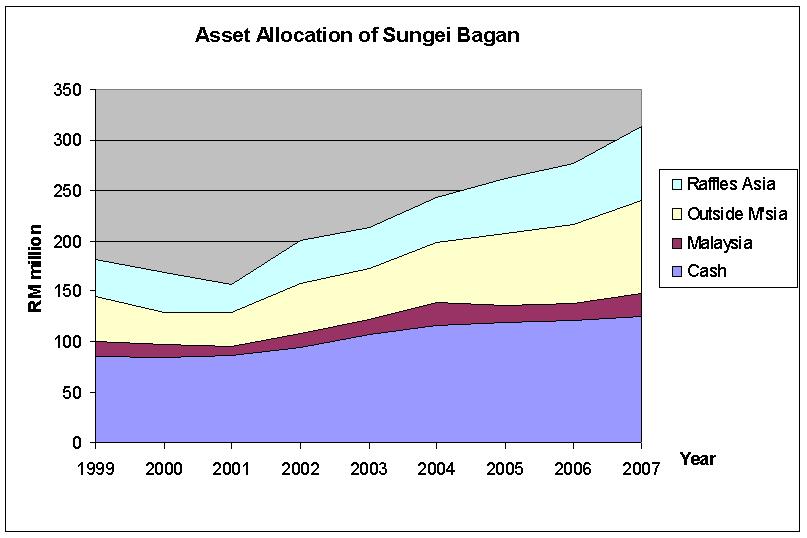
From the table, the value of Sungei Bagan’s portfolio has shown a CAGR of about 7% in these years. The value of this portfolio at Jun-2007 is equivalent to about RM5.20 per share. Now the market price of Sungei Bagan is about RM2.80 per share, which is quite low as compared to its assets.
.
Valuation:
According to the Q2-FY2008 report, the combination of Sbagan’s portfolio at Dec-2007 was as follow: CASH RM 132 million, Quoted Shares RM 107 million, NAV of Raffles Asia (approximate) RM 70 million.
Total value of this portfolio is about RM 309 million.
Due to the current economics climate, many are expecting that the stock market will continue to fall. So, to be conservative, let’s make a 50% discount on the value of quoted shares held by Sungei Bagan. This will reduce its portfolio value from RM 309 million to about RM 220 million, which is equivalent to about RM 3.60 per share.
So, Sungei Bagan’s current share price of RM 2.80 is surely lower than its value.
.
Risk
Because a big part (about 60%) of Sungei Bagan’s portfolio is investment in stock market, its equity will shrink when the stock market is going down. This is the risk that we had to consider.
However, with its current combination of equity, even if the stock market plump 80% from JUN-2007’s level, Sbagan’s portfolio would still worth RM 2.70 per share. If we add in the value of its fixed assets, Sungei Bagan share should worth at least RM 3.0 in this worst scenario.
.
Driver:
If we accept my valuation of RM3.60 per share as the intrinsic value of Sungei Bagan, then the current share price of RM2.80 will give us a safety margin of about 20%. This may not be enough for some conservative investor.
What we can do now is just keep it in the watch list. In my opinion, some event in the near future, e.g. the burst of palm oil price bubble (I believe that it’s just around the corner) would probably give us a best opportunity to buy in Sungei Bagan with a very satisfactory margin of safety.
.
Clonclusion:
Intrinsic value: RM3.60
Classification: Asset Play.
.
Haven't update this blog for almost a month... quite busy during these few weeks...
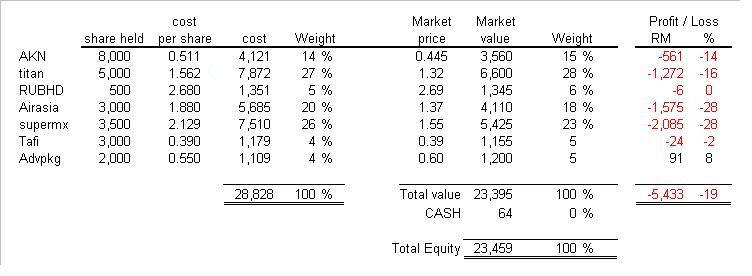
So, here's my portfolio's value at the end of 1Q-2008:
Comment:
1. A cash of about RM1550 (mainly come from my bonus salary) had been added in to my portfolio during this quarter. Due to its very attractive price, I had increased my investment in Supermx to 3500 shares, as compared to 2000 shares in the last quarter.
2. As mentioned in my previous post, Tafi & Advpkg were selected into my "value-stock" portfolio due to Graham's asset-orientated valuation.
3. I didn't see any big change of fundamental condition in my companies, except for AirAsia which has doubled its EPS in the 1H-2008.
4. Due to some negative emotions in the market, my companies are now being transacted in very attractive prices. I really want to increase my investment in these companies (and some new candidates that I've been monitoring so far). But unfortunately, this few months I'm facing some difficulty in my personal finacial management, where I'm spending almost every ringgit that I earn, leaving no cash for my investment. I hope that this condition will not last for too long, because I really don't want to miss this "mega-sales" of stocks in the current investment climate.
.


