21 April 2008

My Portfolio at 31-Mar-2008

Haven't update this blog for almost a month... quite busy during these few weeks...

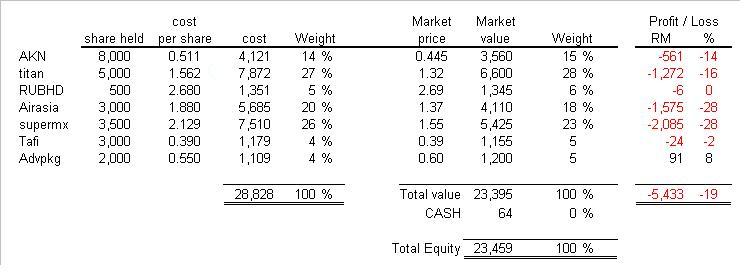
So, here's my portfolio's value at the end of 1Q-2008:

Portfolio-2008-03-31

Comment:

1. A cash of about RM1550 (mainly come from my bonus salary) had been added in to my portfolio during this quarter. Due to its very attractive price, I had increased my investment in Supermx to 3500 shares, as compared to 2000 shares in the last quarter.

2. As mentioned in my previous post, Tafi & Advpkg were selected into my "value-stock" portfolio due to Graham's asset-orientated valuation.

3. I didn't see any big change of fundamental condition in my companies, except for AirAsia which has doubled its EPS in the 1H-2008.

4. Due to some negative emotions in the market, my companies are now being transacted in very attractive prices. I really want to increase my investment in these companies (and some new candidates that I've been monitoring so far). But unfortunately, this few months I'm facing some difficulty in my personal finacial management, where I'm spending almost every ringgit that I earn, leaving no cash for my investment. I hope that this condition will not last for too long, because I really don't want to miss this "mega-sales" of stocks in the current investment climate.

.

18 March 2008

Two value-stocks: ADVPKG and TAFI

Here, I 'd like to introduce two stocks, which I picked into my value-stocks portfolio.

Advance Packaging Technology Bhd.

Last week, I bought this counter at a price of RM0.55. Its net working capital per share is about RM0.81. Hence the price/net working capital = 0.68, giving me a quite satisfactory margin of safety. Others factors that make it a value-buy are:

  • Zero debt.
  • Stable Revenue and profit in the pass ten years
  • Consistent dividend payment. (the average net DY is about 5%)
  • Plenty of cash in the company. (Cash per share = RM0.63)

Its PE ratio is about 9, not very attractive. But with the above criteria, I think buying this stock with RM0.55 is a good and safe investment.

.

Tafi Industries Bhd

I bought this counter at the beginning of March. With a buying price RM0.39, its price/net working capital is about 0.93.

Some good criteria found in this company are:

  • Zero debt.
  • consistent, and relative high dividend. (three years average of net DY = 7%)
  • Low PE ratio. (three years average PE = 5.4)

Besides, its profit shows a gradually growth during the past three years. Hence, with its low PE and good DY, I'm willing to have it in my portfolio although the margin of safety is not that much.

.

16 March 2008

My New Portfolio – with the Graham’s Value-approach.

As I mentioned few months ago, I’m planning to swift my stock-selecting method to Graham’s way. Thanks to Hong Leong Broking which maintains its minimum brokerage fee at RM12, allowing me to buy stock at smaller lots, with low transaction fee. Last month, I’ve opened a trading account with HLeBroking, and I’ve started this portfolio in the early of March.

The purpose that I set up this portfolio is to carry out an “experiment”, to test whether I could generate a good return with this approach. In his 48-years of investment life, Walter Schloss has showed that Graham’s method can give an compound return rate of 20%p.a., almost as same as Buffett’s record.

In this separated portfolio, I will select a number of undervalued stocks, simply based on their assets. I’m not going to study deeply into their business model, nor am I going to make a detail analysis about their future prospect. I’ll just concentrate on figures, not people. Everything is based on the historical data, not future forecast. More attention will be paid on analyzing their assets instead of earnings.

Before I started this portfolio, I had listed down some rules for the screening purpose:

First, I’m not going to invest into a property or plantation company. This is simply because I don’t have confidence in estimating the value of land-properties. However, I’ll still invest in such a company if it consists of high-liquidity-assets, and its share price below the value of these assets.

All the companies selected into this portfolio must have a price lower than its net-working-capital. Here, I’m using Graham’s definition, where “net-working-capital” equals to current assets minus total liabilities. As we know, Graham suggested to buy into stocks which is priced below two third of its net-working-capital, leaving a 33% safety margin. However, I think this rule is too strict, where I hardly find a counter on KLSE that comply with it. So, I use a lower standard-- price below net-working-capital as my first screening filter.

Since my requirement on net-working-capital is less than what Graham suggested, I have to set a few more screening criteria to lower my risk of investment. Some of them are:

  • no debt (or very little debt).
  • the PE ratio must be lower than 10.
  • has a consistent record of dividend payment.
  • not suffering loss during the past few years.
  • the current price level should be at least 25% lower than its peak in the last 24 months.

I hope that I could find at least 10 counters from KLSE which can meet all the above stated criteria. I'll invest about RM1,000 in each of them, to form a diversified portfolio of value-stocks. Of course, I understand that ten counters is not actually diversified enough, but currently I only have about RM10 thousand budget for this.

Due to the low invest amount in each counter, the transaction fee (in and out) will be a bit higher, about 2% ~ 3% of invested amount. But if this portfolio can generate an average return of 20% p.a., I don’t think that transaction fee is a big matter.

To find a stock that meets all the above criteria is not an easy job. Currently, I have only four candidates in my hand. I’d already invested into two of them, in the beginning of this March (I’ll discuss them in my next post). I'll continue the searching until I've found ten of them.

TaTa...

.

08 March 2008

Comment on Quarterly Reports 31-DEC-2007

AirAsia

Showing a good great result despite the high oil price, half-year profit shows an increase of more than 100%. There's a foreign exchange gain of RM 134 million included in the half-year PBT of RM 276 million. Excluding this item, the half-year PBT will be only RM 142 million (about 6.0 sen per share). AirAsia only hedge 30% of fuel for the period until Jun-2008, quite a worrying figure. However, the losses in IAA and TAA had been improved in the quarter. With the newly delivered Airbuses, I believe that they will become profitable soon. I've decided to hold the share of company, but not going to increase my investment unless the price fall below RM1.40.

.

AKN

It suffered a loss of RM 2.3 million in the quarter. This is due to the provision for diminution in value of investment in Subordinated bond of RM2.425 million, and the loss on sale of marketable securities of RM4.58 million as a consequence from the winding down process of the DDD subsidiaries in HK and China. Excluding these special items, the group would have generated a PBT of RM 4.7 million (about 4 sen per share).

.

RUBHD

Show an improved result as compared to last year. There’s still no announcement being made regarding the license migration under WSIA. Last week, the major shareholder RUBHD, Lambang Optima announced that it had just disposed almost all of its holding of RUBHD shares (about 7% of RUBHD total number of share). I still need more time to observe this company.

.

SUPERMX

Continue to show growth in both revenue and profit. The 12-month figures show that its profit margin is almost remained as the previous (2006) level. However, the 4th quarter’s margin falls significantly to about 8.2% only. Recently the share price of Supermx has gone down sharply. I had increase my investment this company, because I'm in an opinion that its current price is very attractive ( PE < 8).

.

TITAN

As expected, EPS for the quarter is only 3.6 sen. The whole year profit has decrease for 13% as compared to 2006. A tax-exempt dividend of 3.0 sen is proposed. Total dividend for the year is equal to 28% of net profit, a bit lower than its announced dividend policy (30% payout rate). Thought the feedstock price has rise to a record high, prospect for the company is still good, as the demand for polymers (especially PE) remain strong. I believe that the shrink in refinery margin is just temporarily. And the Indonesia plant’s production is only 169KT for the year 2007, still below 40% of its capacity. The new butadiene plant will start to generate profit for the company in Q1-2008.

.

03 February 2008

AirAsia: the McDonald’s in aviation industry?

Few days ago, I found that AirAsia’s business model is somewhat similar to McDonald’s -- It is going to generate a huge income from the leasing of aircrafts.

The story of my discovery started from last year, when I realised that I had made a serious mistake in analysing AirAsia -- I ignored the deferred tax item in its financial statement. Since then, I had gone through AirAsia’s financial report again, again, and again, just to make sure that there’s nothing else that I’ve missed.

Then, I discovered an interesting item in the reports —- the aircrafts.

First, let’s introduce two entities that's related to AirAsia -- Thai AirAsia (TAA) and Indonesia AirAsia (IAA). Some people may think that TAA and IAA are subsidiaries of AirAsia. But, in fact, they are not wholly owned by AirAsia. TAA is only a jointly controlled entity of AirAsia, and IAA is an associate company. Both of them started their operation in 2004, and AirAsia only owns 49% stake in each of them. AirAsia had paid USD 5.26 million (about RM 20 million) to get the 49% share of TAA, while IAA’s only cost AirAsia USD 2.00 (two dollars).

Since beginning of their operation, TAA and IAA never own an aircraft. All the aircrafts in operation are either owned by AirAsia, or leased by AirAsia from other parties. AirAsia then lease or sublease these aircrafts to TAA and IAA. They would then, of course, pay a rental fee to AirAsia.

The table below show how much money AirAsia had collected each year, from the leasing of Boeing aircrafts to TAA and IAA. I have included the PBT and Net Cash from Operation of AirAsia in this table, for comparison purpose.

lease

As we can see, the income from leasing aircrafts is quite significant when compared to AirAsia’s PBT, or operational cash.

However, the actual earning from these leasing activities should be quite small, because most of these aircrafts are not owned by AirAsia. (The company only owns six Boeing aircrafts). AirAsia lease the Boeings from other party and sublease them to TAA or IAA. I don’t think AirAsia can make a good profit out of this.

But in the next few years, AirAsia’s fleet size will grow dramatically. Due to the latest information, it has 175 confirmed order of Airbus. According to the current planning of AirAsia's management, more that half of these aircrafts will be leased to TAA or IAA. Then, the rental income may have a great contribution to AirAisa's profit.

This is similar to what McDonald’s did about 50 years ago. In the early stage of its expansion, McDonald’s signed long-term lease-contracts with some property owners to rent their properties, and then subleased those properties to its franchisees. Later, while McDonald realized the great potential of rental income, it started to buy its own properties. Then, the rental income had gradually become the most important part of its profit.

So, while AirAsia's fleet size is expanding, will the rental income (of aircraft) gradually play an important role in AirAsia's profit?

Well, maybe it's too early to make a conclusion now. Let's wait and see......

.
Related Posts Plugin for WordPress, Blogger...


SPONSORS: