11 June 2013

Risk Management -- reduce holdings on Power Roots.

I had just sold half of my holdings on Power Roots yesterday.

In his book Common Stocks and Uncommon Profits, Philip Fisher mention that there are on three reasons where a good stocks should be sold:
  •  We had made an error in our assessment of the company.
  •  The fundamental of company has deteriorated and no longer meets our requirement.
  •  We found a better investment which could provide higher long term results.
The fundamentals of Power Root remain great since I invested...
In fact, it performed well much better than I expected initially.
So according to Fisher's points I had no reason of selling it now unless there's is a much better investment opportunity.

Incidentally, I just found a great company recently that meets my long-term-investment strategy, and the cash on hand is limited... So this sale of some Power Roots share just come at a right time to fund my new investment.

 x x x

However, there's a more important reason for the reduction in holdings -- to accomplish my portfolio's diversification policy.

For risk management purpose, I always want to maintain an adequate degree of diversification. So, I had set some guidelines to limit my exposure to any single companies or industry.

My portfolio contain companies of different sizes, and I had set different exposure limit for different size of companies. The reason is obvious -- smaller companies tend to have higher risk than big ones, hence should take up smaller share in a portfolio.

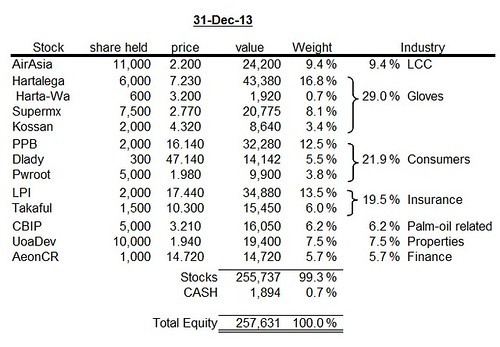
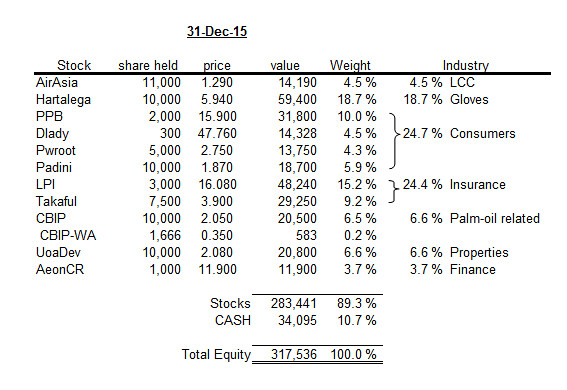
For companies below RM1 billion (market capital) I had set a 10% limit for their weight, while big companies like Harta and LPI could have a limit as high as 20%... At the same time, I also make sure that the weight on any single industry must not exceeded 30%. (currently my holdings on gloves, namely Harta, Supermx, Kossan had a total weight of ~28%).

Power Root is the smallest company in my portfolio (mkt cap ~670m). It weight only ~5%  when I invested in it. However, the share price climbed up so fast that the weight come to ~12% recently. This make me a bit uncomfortable, hence the reduction of holding came into place.

 x x x

After selling half of the investment, the weight of Power Roots had now become ~6% in the portfolio. I will be holding this part of shares as long as the fundamentals of the company remain strong...

In future if the share price of Power Roots boost up for another round and break my 10% mark again, I would probably just keep it then, because by that time it would be considered as a medium size company already.

.


31 May 2013

CB Industrial Product Holding Bhd.

Got to know this company recently through an investment forum.

I like this company very much after doing some research... It got so many criteria that I'm looking for, and no doubt a candidate of long-term growth stocks.

CBIP is a leader in its niche market -- construction and engineering of palm oil mills. The company had been in this business for more than three decades, and had built a very strong customer base... Felda, Wilmar, Sime Darby, TradeWinds Plantation, etc.,  are among its customers. One of its main product, Modipalm Continuous Sterilization System, is patented in Malaysia and Indonesia till 2021.

One thing I like very much regarding the core business of CBIP -- it's relatively less impacted by the fluctuation of  CPO price. Its customers (the palm oil plantation companies) effectively act as a buffer between CBIP and palm-oil market... So, investing in CBIP is like enjoying a piece of pie from the huge palm-oil economics, without taking the risk of CPO price plunge...


Besides these, CBIP had been doing business in retrofitting of special purpose vehicles. It also had associated and JV which involves in palm-oil plantation. Currently the contributions from this two segment are relatively small. However, the profit from associates and JV could leap high if the CPO price rebound.


 x x x


Ten-years financial performance: (full view here)


 * Revenue and profit for FY2011 & 2012 are excluding the discontinued plantation business and one-off gain from disposal of subsidiaries.


Highlights:
  • Strong consistent growth record -- 16% CAGR for revenue and 24% CAGR of profit during past ten years. 
  • High ROE -- 22% (ten year average), and it's quite consistent.
  • Good profit margin, and it show a gradually improving trend over years.
Currently, the company has only little debt, and posses huge cash.

x x x

Short-term prospect:

Resulted from the high CPO price during past few years, currently we are experiencing a boom of new palm-oil estate, especially in Indonesia... during these years, we saw new players entering palm-plantation business, while existing players developing new estate... So, in the next 3~5 years, there will be huge demand on palm-oil-mills constructions to absorbs all these new FFB production.

The momentum of this palm-estate expansion wave in Indonesia is going to last for few years even if the CPO price remain low... so I'm seeing a strong sustainable growth on CBIP's core business, and expecting a CAGR of >20% in the next five years.

x x x

Long-term prospect.

CBIP had been buying plantation lands in Indonesia recently... Currently it already accumulate ~30k ha of landbank, and the figure will jump to 60k ha upon the completion of another two acquisition.

In the next few years, the company will plant these lands with oil-palm, and construct CPO mills in the estates. We will see the contribution from these estates on ~2018 onwards...

When the estates come to mature and start production, they will transform the company into a medium size palm-oil players, and CBIP will going to experience another leap of revenue and profit... maybe 20% CAGR for another 5~10 years?


The land banks of CBIP and its planting plans:(source: CBIP Investor Relation.

CBIP plantation subsidiaries 2012


CBIP planting schedule

There's a possibility that CBIP won't seriously venture into plantation segment, but instead sell all those estates when they come into mature. (like what it did to two of its subsidiaries recently)... If this happen, then we will see a round of huge one-off profit in its income statement... good news for shareholders though...

 x x x

My Investment:

The company posses an EPS of ~32sen for FY2012... I bought the shares at RM2.88, which is equivalent to ~9x PE, a quite reasonable price I think.

Past records show that pay-out ratio of the company was quite low (exception on 2012, when the company received huge cash from the disposal of plantation subsidiaries). Hence I didn't expect much from its dividend yield...

Expected term of investment: five years, hopefully would be longer.
Expected return: 20% p.a., mainly from stock price gain.

x x x

The investment in CBIP made up ~7.5% of my fund... Combine with TSH, the palm-oil related companies now weigh about 15% in my portfolio.

 -- (End) --
.


30 May 2013

The Myth of Nitrile Glove's higher margin.

I was among those who think that nitrile glove always had a higher profit margin, hence it should be the better choice for a glove manufacturer...

only untill recently I realised that how wrong this concept is... 

Just like AirAsia making huge profit every year doesn't guarantee that other airlines could earn money in LCC business.... the fact that Hartalega had been maintaining better profit margin doesn't mean that anybody who venture into nitrile glove production will enjoy the same profitability...

Hartalega got its own advantages, e.g. strong R&D and highly automated factory... these factors bring down its cost, make the products competitive enough hence resulted in higher profit margin.... when other manufacturers like Topglov, Supermax or Kossan jump into nitrile glove production, it could be that they only earn ordinary profit (could even lower than NR gloves) if they don't have the high production efficiency as Harta.

following statement is extracted from Supermx 2013-Q1 reports:
"While we are increasing production output of Nitrile gloves, we have been maintaining our manufacturing margins of Nitrile Glove at between 11% - 13% to be in line with global market prices, especially Nitrile gloves from China & Thailand. This is in line with our objective to be globally competitive."

clearly, Supermx's manufacturing margin for Nitrile gloves is much lower that Hartalega, and seems not much superior (if any) compared to its own NR gloves manufacturing...

 x x x

Conclusion --

"higher margin of nitrile glove" is only a myth...

switching to nitrile glove alone doesn't guarantee higher profitability...
there are much more a company have to do for chasing a higher profit margin.

.

29 May 2013

create my FB page.

Had just registered a Facebook account, and created a page with exactly the same name as this blog -- Investment in KLSE .

I had found it much easier to interact with friends through a FB account instead of blog... On the wall of the FB page will be some short notes of my investment activities, moods, and some this & that regarding stocks I monitor...

This blog, will remain as the place for storing my investment articles.

.

23 May 2013

House Cleaning -- sold XDL and Notion.

Being disappointed by their latest financial performance, I think it's time to admit my mistake investing in these two companies.

Notion seems to have facing difficulty in expanding its business since 2010... seeing that the HHD segment is going into downtrend, and Camera market was relatively matured, I'm in an opinion that the growth potential of Notion is limited for the years to come...

for XDL, the shoes market at China is so deteriorated that most local branded products are suffering revenue drop.... XDL encountered 40% drop of revenue and 50% drop of profit in 2013-Q1... and I think that this poor performance will persist for quite a long time...  

Cash-out  about RM17k from Notion and XDL, looking for new target to invest...

Related Posts Plugin for WordPress, Blogger...


SPONSORS: